
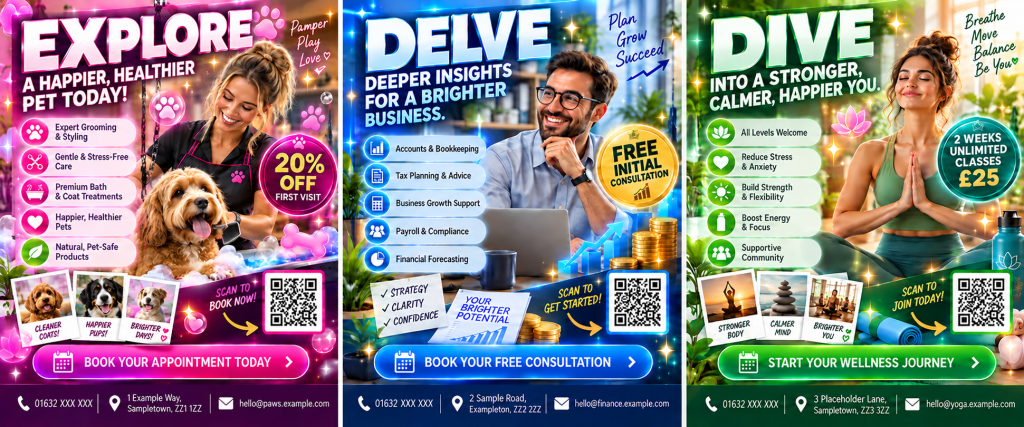
Artificial intelligence has made it easier than ever to create social media content. With a few instructions, businesses can generate captions, images and ideas in seconds.
That can be incredibly useful. I use AI within my own work, and I know how much time it can save when it is used well. The problem is not that businesses are using AI. The problem begins when they allow it to make every creative decision for them.
Scroll through social media for a few minutes and you will probably recognise the signs: the same style of illustrations, the same fonts, the same layouts and graphics packed with so many elements that you are not quite sure where to look first.
Everything may look polished, but very little feels distinctive.
When Every Post Looks as Though It Belongs to a Different Business
I recently came across a Facebook feed promoting a range of activities. Each post had its own AI-generated graphic and, viewed individually, the images were perfectly acceptable.
The problem became obvious when looking at the feed as a whole.
Every graphic was completely different. There was no consistent use of colour, no recognisable typeface, no repeated layout and very little branding. If the company name had been removed, there would have been no way to tell which organisation the posts belonged to.
It felt less like one business communicating with its audience and more like a collection of unrelated images gathered from different places.
That matters because people rarely study every post closely. They scroll quickly. Familiar colours, layouts, photography and language help them recognise who is speaking before they have even read the company name.
If every post looks completely different, that recognition is lost.
More Content Does Not Always Mean Clearer Content
AI image tools can create detailed graphics very quickly. That does not mean every available detail should be included.
When a graphic contains multiple people, objects, backgrounds, decorative elements, headings, icons and several calls to action, the important message has to compete for attention. The viewer’s brain has too much to process, so the post is more likely to be ignored.
A social media graphic does not need to tell the whole story. Its job is often simply to catch someone’s attention and give them a reason to read the accompanying post.
Clear, restrained design is not boring. It gives the message room to do its job.
Your Brand Should Provide the Direction
Using AI does not mean abandoning your existing identity.
Before generating a graphic or writing a caption, there should still be decisions about:
- The purpose of the post
- The main point the audience needs to understand
- The colours and fonts associated with the business
- The type of imagery that feels appropriate
- The language the business normally uses
- How the post will sit alongside the rest of the content
AI can help execute an idea, but the business—or the person managing its marketing—needs to provide that direction.
Without it, the tool will make its own choices. Those choices may produce an attractive result, but they will not necessarily produce something that is recognisably yours.
The Same Applies to the Words
Visuals are only part of the issue. AI-generated captions can also begin to blend into one another.
Certain phrases, sentence structures and styles appear repeatedly. The content may be grammatically correct and neatly presented, but it does not always sound as though it came from a real person within that particular business.
You can often spot the same familiar language appearing across completely unrelated accounts. We are invited to explore every subject, delve into every idea and dive into every topic. None of those words is wrong, but when everybody uses the same vocabulary, the businesses behind the posts gradually become harder to distinguish.
The aim should not be to disguise the fact that AI has helped with the writing. It should be to question the result, remove the phrases that do not sound natural and put the personality of the business back into it.
A dental practice should not sound identical to a tattoo studio. A law firm should not communicate in exactly the same way as a children’s nursery. Each has a different audience, purpose and personality.
Good social media content should reflect those differences.
That means reviewing what has been generated, removing language the business would never naturally use, adding relevant knowledge and making sure the final version sounds like the people it represents.
AI Should Be a Tool, Not the Identity
There is no reason for businesses to avoid AI altogether. Used thoughtfully, it can help develop ideas, explore creative options and make parts of the content process more efficient.
But efficiency should not come at the cost of identity.
The strongest content combines useful technology with human judgement. Someone still needs to decide what belongs, what should be removed and whether the finished post genuinely represents the business.
Your social media does not need to look like everybody else’s simply because the same tools are available to everybody.
Consistency does not mean every post must be identical. It means there is a recognisable thread running through the content: a familiar voice, considered visuals and a clear sense of the business behind it.
Before publishing your next AI-assisted post, take a moment to ask:
If our name and logo disappeared, would anyone still recognise this as ours?
If the answer is no, the content may need a little more of you in it.
At Social Beans, I work closely with businesses to create social media content that is clear, consistent and true to their personality. If your content is beginning to feel disconnected or no longer sounds like your business, book a free meeting and let’s have a chat.